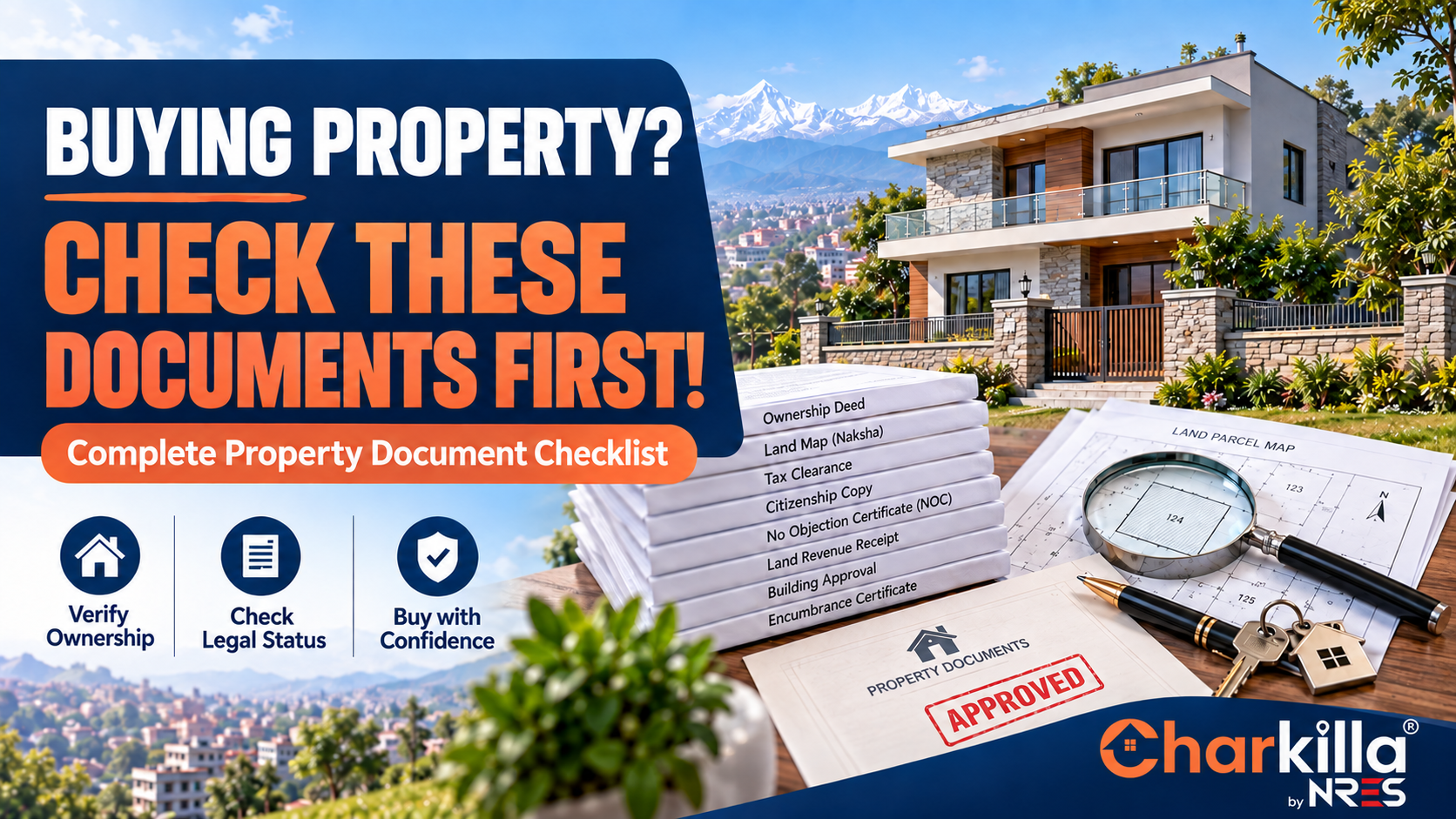
Buying land, a house, or an apartment is a major financial decision. Before making any advance payment or signing an agreement, buyers should carefully verify the property’s ownership, legal status, boundaries, taxes, road access, and construction approvals.
Here is a practical checklist of the most important documents to check before buying property in Nepal.
1. Land Ownership Certificate (Lalpurja)
Check the original Land Ownership Certificate and confirm:
Name of the registered owner
Kitta number
Land area
Property location
Type and classification of land
Any remarks or restrictions recorded on the document
The seller’s citizenship details should match the ownership information.
2. Latest Malpot Tax Receipt
Request the latest land revenue or Malpot tax payment receipt. This helps confirm that the property’s government taxes have been paid and are up to date.
3. Cadastral Map (Napi Naksa)
Check the official cadastral map to verify:
Exact shape and boundaries of the land
Kitta number
Road access
Neighbouring plots
Possible boundary encroachment
The land should also be physically measured by a licensed surveyor before purchase.
4. Field Book and Plot Register
The field book and plot register provide additional information about the land’s measurements, classification, boundaries, and official records. These details should match the Lalpurja and cadastral map.
5. Trace Map
A trace map helps identify the property’s exact location, surrounding plots, and access road. Verify that the land shown by the seller is the same land recorded in the official documents.
6. Seller’s Citizenship or Company Documents
If the property belongs to an individual, check the owner’s original citizenship certificate.
If a company owns the property, verify its:
Company registration certificate
PAN or VAT certificate
Board decision authorizing the sale
Details and authority of the representative signing the documents
7. Ownership Transfer History
Review previous transfer deeds or Rajinama documents to understand how the current owner acquired the property. This helps identify possible inheritance, ownership, or transfer-related complications.
8. Family Consent and Inheritance Documents
If the property is ancestral, inherited, jointly owned, or subject to family rights, check:
Partition deed
Inheritance documents
Death certificate, where applicable
Relationship verification
Consent of all legal owners or heirs
Never assume that one family member has the authority to sell the entire property.
9. Mortgage, Loan or रोक्का Status
Confirm through the relevant Land Revenue Office that the property is not:
Mortgaged to a bank or financial institution
Frozen or restricted from transfer
Under a court order
Connected to an unpaid loan
Subject to another legal restriction
A property under रोक्का cannot normally be transferred until the restriction is officially cleared.
10. Road Access Documents
Do not rely only on the road visible at the site. Verify whether the property has legally recognized road access.
Check:
Road width
Road ownership
Right of way
Access shown on the cadastral map
Local government road records
Any road expansion or setback plans
11. Four-Boundary Verification (Char Killa)
Confirm the property’s four boundaries and compare them with:
The cadastral map
Physical site conditions
Neighbouring properties
Survey measurements
Seller’s declaration
Boundary verification is essential for preventing future disputes and encroachment problems.
12. Building Map Approval
When buying a house or commercial building, request the municipality-approved building drawing or Naksa Pass.
Compare the approved plan with the actual construction to identify unauthorized floors, extensions, setbacks, or structural changes.
13. Building Completion Certificate
Where applicable, check the building completion certificate issued by the relevant municipality or local authority. Also verify property tax records, construction approval, and utility registrations.
14. Property Tax Clearance
Ask for the latest property tax and municipal tax receipts. Outstanding taxes may create difficulties during ownership transfer or future municipal services.
15. Utility Bills
Review recent electricity, water, maintenance, and other utility bills. Confirm that there are no unpaid dues and that the accounts correspond to the property being purchased.
16. Tenancy or Lease Agreement
If the property is occupied by tenants, check:
Existing rental or lease agreement
Monthly rent
Security deposit
Agreement expiry date
Tenant’s rights and obligations
Conditions for vacating the property
Make sure the purchase agreement clearly explains how the existing tenancy will be handled.
17. Sale Agreement or Bayana Agreement
The Bayana Agreement should clearly mention:
Buyer and seller details
Property description and Kitta number
Agreed selling price
Advance payment
Remaining payment schedule
Registration deadline
Responsibility for taxes and fees
Property handover date
Conditions for refund or cancellation
Penalties for non-performance
Confirmation that the property is free from disputes and restrictions
The agreement should be reviewed by a qualified legal professional before signing.
18. Power of Attorney
If someone is selling the property on behalf of the owner, carefully verify the original Power of Attorney. Confirm that it is valid, properly authenticated, and specifically authorizes the representative to sell and transfer that property.
19. Court Cases and Ownership Disputes
Investigate whether the property is involved in:
A court case
Family partition dispute
Boundary dispute
Government acquisition
Public land encroachment
Tenant dispute
Double-sale or advance-payment dispute
Speak with nearby property owners and conduct formal legal due diligence.
20. Planning and Zoning Information
Check with the municipality or relevant authority regarding:
Land-use classification
Building restrictions
Required setbacks
Road expansion plans
Heritage or environmental restrictions
Future infrastructure projects
This is especially important when purchasing property for commercial construction, apartments, plotting, or investment.
Extra Checks for Apartments
Before buying an apartment, also verify:
Developer’s company registration
Project and building approvals
Land ownership
Apartment ownership certificate
Completion and occupancy documents
Parking allocation
Common-area ownership
Maintenance charges
Owners’ association rules
Bank mortgage or project liabilities
Final Property-Buying Checklist
Before completing the transaction:
Inspect all original documents.
Match the seller’s identity with the registered owner.
Verify the property at the Land Revenue and Survey Offices.
Measure the land through a qualified surveyor.
Confirm legal road access.
Check mortgage, रोक्का, court case, and dispute status.
Review building approvals when purchasing a house.
Consult a property lawyer.
Use a written service and purchase agreement.
Make payments through traceable banking channels.
Complete legal registration before taking final possession.
Need Professional Real Estate Help?
Property documents can appear correct while still containing boundary, access, ownership, mortgage, or approval-related risks. Professional verification before payment can protect you from costly disputes and fraudulent transactions.
For help with property buying, selling, rental, documentation, due diligence, valuation, site visits, and legal coordination, contact:
CharKilla.com by Nepal Real Estate Solution
Your Trusted Property Partner in Nepal
🌐 www.charkilla.com
Disclaimer: This information is provided for general awareness only. Property requirements may vary according to location, property type, and current government regulations. Always obtain verification from the relevant government offices and qualified legal professionals before completing a transaction.